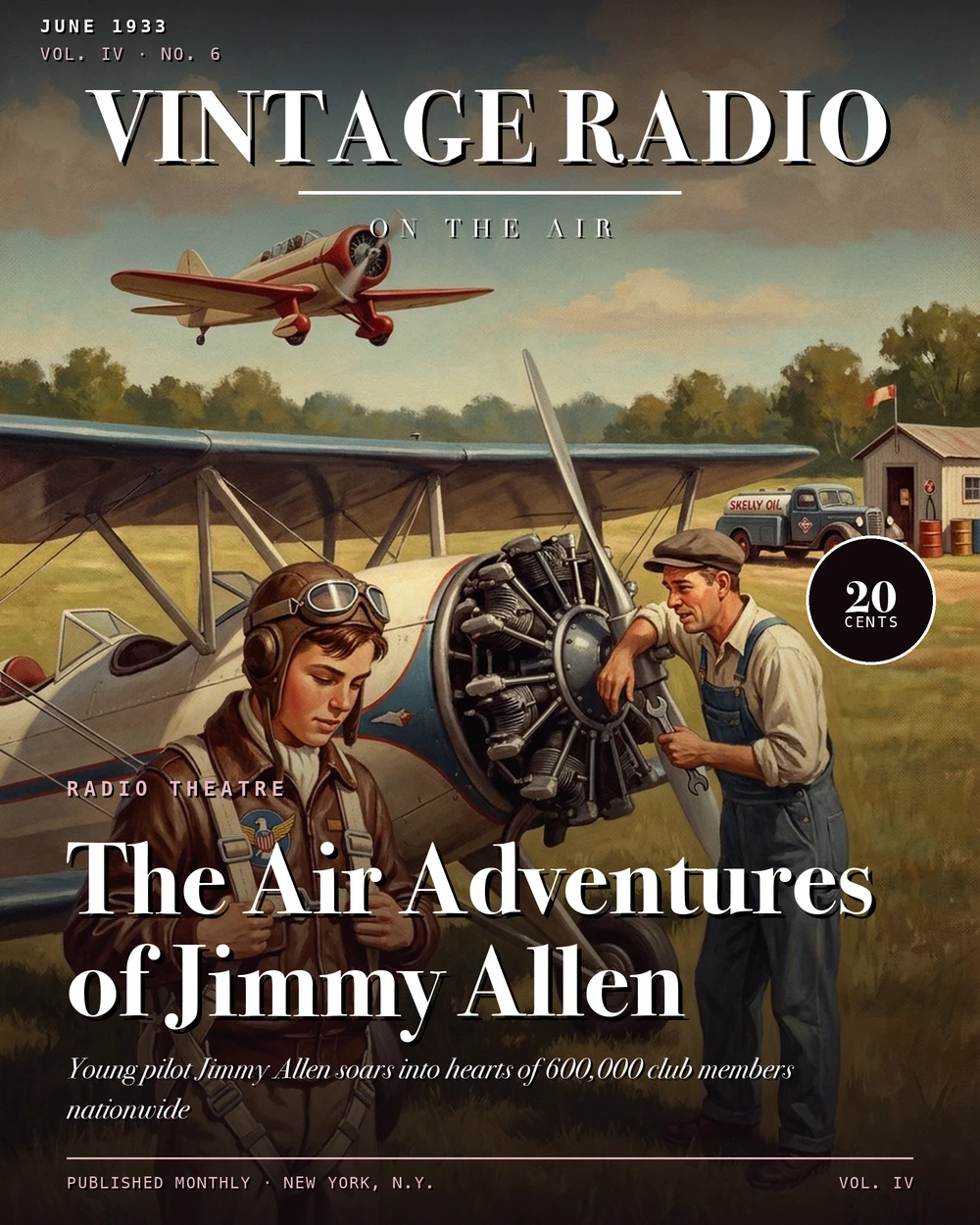
The Air Adventures of Jimmy Allen
How It Got on the Air
The Air Adventures of Jimmy Allen didn't start in a broadcast studio or a network programming office — it started at a party in Kansas City. Bob Burtt and Bill Moore, a pair of World War I flying aces who had since become writers, floated the idea of a serial about a teenage boy pilot at a social gathering. Burtt's path to that party was its own adventure: born in West Newton, Massachusetts, in the mid-1890s, he had spent ages ten through sixteen in the interior of China with his missionary parents, working his way through Dumas and Victor Hugo. He enrolled at MIT as an aviation cadet in 1917, served as a first lieutenant in the 28th Pursuit Squadron in France, then came home to barnstorm before being named head of Kansas City's new Bureau of Aviation in 1928. Moore, meanwhile, was working the sports desk at the Kansas City Star and holding air speed and altitude records in an Inland Sport Plane.
Moore brought the pilot script to WDAF, where station manager Dean Fitzer put it into production. During sponsorship auditions, ad man Russell C. Comer was called in, became impressed with the serial's possibilities, and sold the package to Skelly Oil — with the local stipulation that the show air on WDAF exclusively. On February 23, 1933, the program went out over three stations: KDAF in Kansas City, KLZ in Denver, and KVOO in Tulsa. Within weeks, seven more had signed on.
What made the launch unusual was its structure. The show was transcribed rather than broadcast live, and Comer never sold it to a network at all. Instead he marketed the show himself — to Richfield Oil Company on the West Coast and to scores of individual businesses elsewhere — and kept control of the property. World Broadcasting handled syndication outside the Skelly market, with the initial transcriptions made at World's Chicago studios before production moved among facilities in Hollywood, New York, and Chicago over the years. The result was a footprint that spread steadily across the country without any major network having much to do with it, which is part of why the show's history remained vague for decades until enthusiast Walter House tracked down and published the full record in a two-part article in RJC Model Builder in 1980.
The Show Itself
Jimmy Allen, as written by Burtt and Moore, was a 16-year-old boy pilot — introduced as a young telegraph messenger at the Airways Station near Kansas City who, in the earliest story arc, uncovers a plot to hijack a plane carrying a million dollars to a bank and enlists Speed Robertson's help. John Frank played the role across the entire original run, a quietly odd casting choice since Frank was more than 40 years old when the series began. Frank had originally been hired by Comer to direct the program; he simply decided to take the lead role as well. Robert Fiske played Speed Robertson in the 1930s run, with Art Ellison and Al Christi rounding out the original cast. When the show needed a teenage face for personal appearances, they hired Murray McLean — actually 16 years old, the son of radio actress Betty McLean, and a trained pilot — to stand in while Frank kept the microphone.
Burtt and Moore consciously built Jimmy as "a self-reliant youth of fine habits: resourceful, courageous, capable of thinking his way through danger," and surrounded him with friends and enemies designed to throw those qualities into relief. Speed did the flying and taught Jimmy tricks learned in the Great War; by the end of the initial story arc, he was revealed to have been made an FBI G-Man. The 15-minute episodes covered the territory you'd expect from an aviation adventure serial for kids — air races, treasure hunts, mysteries — but the show didn't shy away from adult subject matter that was considered unusual for juvenile fare at the time. The characters solved murders alongside the chases and capers. In one storyline, a passenger named Quackenbush died under circumstances that needed investigating. The recurring villains were Black Pete and Digger Dawson, and Jimmy's circle included his mechanic, Flash Lewis, alongside Speed.
The Club That Took Over the Midwest
The Jimmie Allen Flying Club was the show's promotional engine, and by any measure it ran hot. Children could join by applying at any Skelly station, and the premiums they received — a set of wings, a membership emblem, and a personal letter from Jimmie Allen himself — were enough to get the operation moving. From there the giveaways kept coming: a picture puzzle showing a Skelly truck refueling a light airplane, a secret service whistle, a Jimmie Allen album. The club newspaper went out to 600,000 kids a week, and across all the regional sponsors the membership eventually topped three million.
The show's reach went beyond mailboxes. Jimmie Allen Air Races were held in major Midwest cities, drawing tens of thousands of spectators. Listeners who showed up at a Skelly station with their club credentials could access flying lessons — at least five of them, plus a final exam and a diploma — along with model plans built to specifications that the club then raced at exhibitions. On the West Coast, Richfield Oil ran its own operation from an office at 901 Harrison Street in Seattle, where members were known as "Flight Cadets" and pledged "to do all in my power to make America first in the air. To promote American commercial, transport and military aviation." Richfield's flagship aircraft for the campaign was a 1929 Stearman Model 4E Speedmail, registration NC667K, flown by chief pilot Dudley M. Steele as a fixture of the Jimmie Allen Air Races. Charles Lindbergh flew the same aircraft at Burbank on April 2, 1930. Skelly, for its part, had to hire a dedicated staff just to manage the mail. As Walter House put it, the show existed in an era "when kids, radio, and aviation were growing up together," and the club made that connection tangible in a way kids could touch and display.
The Path to the Screen — and to Captain Midnight
By 1936, the character had built enough name recognition that Paramount shot a feature film called The Sky Parade, released April 17, 1936, and directed by Otho Lovering. Burtt and Moore wrote the screenplay with Brian Marlow, and the picture starred William Gargan, Katherine DeMille, Kent Taylor, and Grant Withers alongside the actor billed as Jimmie Allen himself. The film introduced an autopilot device and air-to-ground radio communication as plot elements; film historians have noted it as the first picture in which an unqualified pilot is "talked down" by radio from an airport control tower. Paramount optioned it as the first of a planned series of Jimmie Allen pictures through Arthur F. Beck's Air Adventures Corp., though no sequels followed.
A year later, in 1937, Skelly dropped the show. The reasons aren't detailed in the historical record, but the timing was significant: after parting ways with Jimmy Allen, Skelly turned back to Burtt and Moore and started working with them on a new aviation serial. That collaboration, developed at the Blackett, Sample and Hummert agency in Chicago, first aired on October 17, 1938, as Captain Midnight — with Ed Prentiss, the announcer on Jimmie Allen, in the title role. Burtt would also go on to write for Sky King, Ann of the Airlanes, and Hop Harrigan.
The original Jimmy Allen run ended, but it didn't disappear. Repeats circulated across the country — and in Australia, Canada, and New Zealand — until 1943. Then, from 1946 to 1947, more than 400 new 15-minute episodes were recorded and broadcast in a postwar revival sponsored in part by the International Shoe Company of Kansas City. Shelby Storck stepped in as Speed Robertson, providing continuity, with Twila Comer as Jimmy's girlfriend Barbara and Al Christy — a WDAF announcer born Albert Christopher Ladesich in Kansas City, Kansas, who later became the station's main television weathercaster — as Flash Lewis. (The lead actor's name is variously given as Jack Schlicter and Jack Anthony, depending on the source.) The revival wasn't successful, and the show didn't survive into the next decade.
Why It Holds Up as History
The Air Adventures of Jimmy Allen occupies an interesting corner of old-time radio history precisely because it operated outside the conventional network structure. Most shows of its era were defined by their NBC or CBS runs; Jimmy Allen was defined by its regional oil company sponsorship, its self-syndication model, and its grassroots promotional machine. The result was a show that reached an enormous audience — millions of club members across all regions, tens of thousands at live air races — without the kind of network infrastructure that would have left a cleaner paper trail.
The creators' instincts proved sound when Captain Midnight became a long-running fixture of the adventure genre. But Jimmy Allen came first, and the promotional model Comer built around it — the club, the premiums, the live events, the tie-ins at the point of sale — was an early and ambitious attempt to turn a radio serial into something that extended off the dial and into everyday life. Commemorative Air Force materials have credited the series and its Flying Club as tools that "greatly influenced the generation that would fly in WWII." That the show's complete history had to wait nearly fifty years for Walter House to reconstruct it says something about how thoroughly the non-network world of 1930s radio was overlooked — and how much of its reach was real even when the trail back to it had nearly gone cold.